01 / PRACTICE
Pronunciation Practice Page
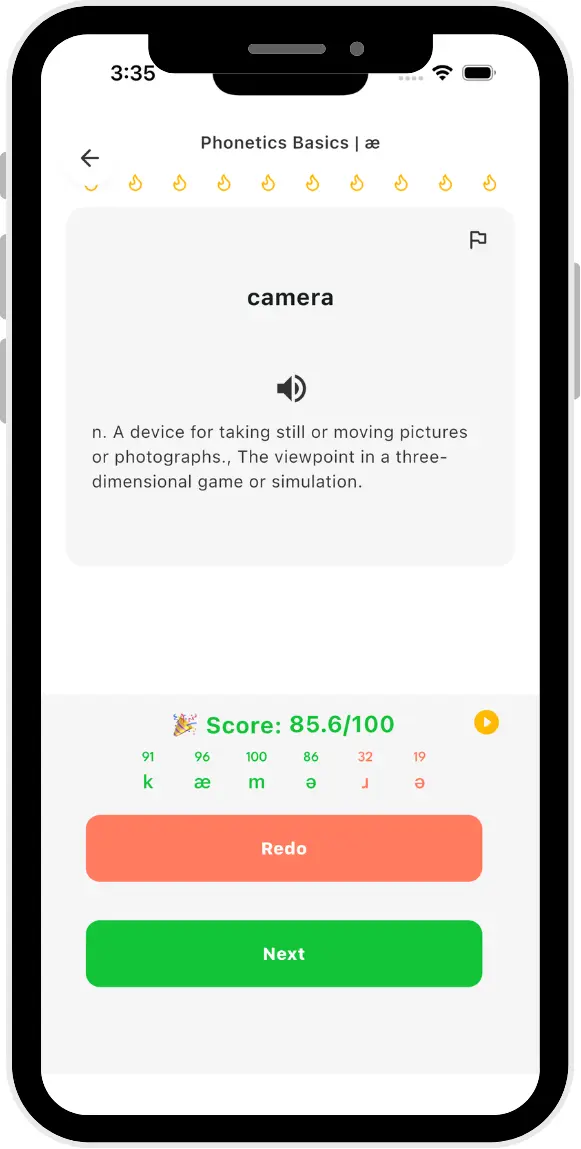
Practice pronunciation with phonemes, words, and sentences. After practice, you can check pronunciation scores and feedback as learning aid information.
DORS.AI PRONUNCIATION PRACTICE
DORS.AI includes phoneme pronunciation practice, pronunciation scores and feedback, and practice for specific pronunciation challenges.
Speaking is not a practice entry point. It is a data center that organizes practice history so you can review pronunciation weaknesses and recent changes.
WHAT THIS PAGE EXPLAINS
Pronunciation Practice is where you actually speak and receive results and feedback. Speaking is where you review that history to decide which sounds and words to practice again.
01 / PRACTICE
Practice pronunciation with phonemes, words, and sentences. After practice, you can check pronunciation scores and feedback as learning aid information.
02 / SPEAKING
Collects pronunciation practice history, showing an overall summary, per-element past performance, and recent changes. From here, you find weaknesses and connect them to your next practice and learning plan.
FROM PRACTICE TO INSIGHT
Pronunciation practice results don't end with a single score. As history accumulates, it connects to information you can review in Speaking and to your next actions.
Speak phonemes, words, and sentences aloud, and check pronunciation scores and feedback.
Individual pronunciation practice results accumulate as pronunciation practice history.
Check the overall summary, per-element past performance, and recent changes.
Find weak words and sounds, and connect them to related practice or pronunciation tasks in your Personalized Learning Plan.
THREE LEVELS OF PRACTICE
Pronunciation is practiced not only with individual sounds, but also within words and sentences. Using Speaking's history makes it easier to organize which granularity to focus on.
Identify weak phonemes and practice them together with words that contain those sounds.
Find weak words from practice history and work on practice for commonly mistaken words.
In the Personalized Learning Plan, sentence pronunciation tasks may be included depending on the situation.
WHAT YOU CAN SEE
Displayed items may vary depending on practice history and screen. You use the information confirmed here to choose your next practice.
FROM SPEAKING TO PLAN
Speaking data serves as the basis for pronunciation tasks in your Personalized Learning Plan. Weak words, weak sounds, and sentence pronunciation challenges found from practice history become candidates for what to work on next.
In other words, speaking aloud on the practice page and reviewing history in Speaking have different roles. Connecting both makes it easier to move pronunciation practice into your next action.
Practice → History → Speaking → Weakness practice
The Personalized Learning Plan may include tasks for commonly mistaken words, weak phonemes, and sentence pronunciation. See Personalized Learning Plan for the full picture.
WHO IT IS FOR
NOT FOR THIS PURPOSE
Pronunciation scores and feedback are learning aid information within DORS.AI. They are not substitutes for exams, certifications, or formal proof of ability.
They are not language ability or medical diagnoses, and do not guarantee specific improvement or results.
PLATFORMS
Pronunciation Practice and Speaking are available on iOS, Android, and Web. Current features are shared across all three platforms, and you can use one account with learning data syncing across all three.
The Chrome Extension is a reading aid tool for Japanese web pages. It is not an entry point for pronunciation practice or Speaking. For details, see the Web vs App comparison page.
FAQ
NEXT STEP
You can explore pronunciation practice, Speaking's role, the DORS.AI overview, learning plan, and usage conditions on related pages.